A relationship over 8500 kilometers
Mongolia and Europe
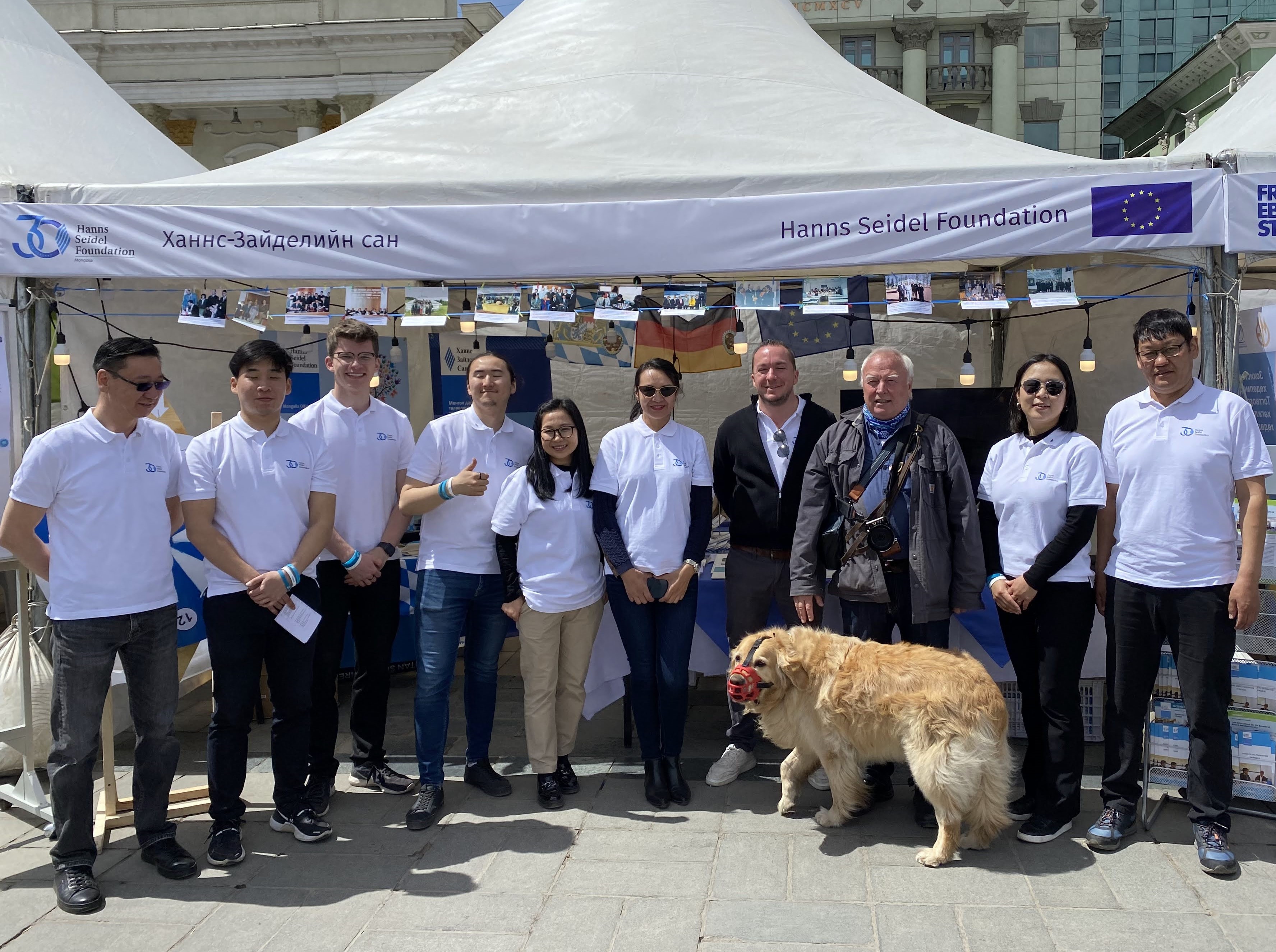
“Europe Day 2023” was also celebrated in Mongolia a week after the original date. While the first days of May promised a big party for Europe in Brussels, in Mongolia this is still a time when snow and sub-zero temperatures can dampen the mood. So, with a little delay, over 70 stands from European embassies, international organizations, NGOs and companies were able to celebrate Europe on Sukhbaatar Square in Ulaanbaatar and present themselves and lots of useful information. The HSS was also represented.

The HSS Mongolia team at “Europe Day 2023”.
The view to the west
But why is the EU important for Mongolia, given that Ulaanbaatar and Brussels are literally worlds apart geographically at over 8,500 kilometers? Mongolia faced massive challenges after the collapse of the Soviet Union. Although it was formally independent beforehand, as the second socialist state in history, the country was a 'satellite state' of the USSR. After the collapse of the USSR, the focus was mostly on the West and Europe.
The Hanns Seidel Foundation commenced its work in the legal field in 1993, focusing primarily on legal development in constitutional law, administrative law, and criminal law. Presently, Mongolian law exhibits a strong orientation towards German law, implying potential collaboration for further advancements in Mongolian legal frameworks. Over the past three decades, institutions from EU member states have significantly influenced the democratic development of Mongolia through bilateral cooperation in numerous other areas as well.
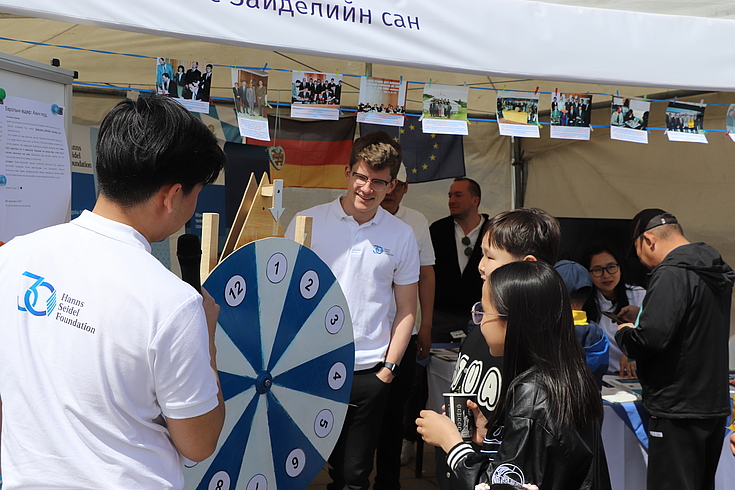
The HSS supports the development and dissemination of law in Mongolia - here with the Wheel of Fortune and legal issues relating to Germany, Mongolia and the European Union.
Overcoming dependencies
At the foreign policy level, Mongolia's 'third neighbor policy' is also noteworthy in this context. Despite heavy dependence on its immediate neighbors, China (with exports from Mongolia to China alone accounting for between 70-90% in the last five years) and Russia, Mongolia actively pursues close ties with third neighbors in Europe and the EU. Presently, the EU stands as the largest donor of development aid, supporting projects in sustainable development, environmental conservation, the rule of law, and climate change mitigation. A partnership and cooperation agreement, established in 2010, aims to enhance political dialogue. Additionally, emphasis is placed on student exchange programs and extensive collaboration among scientists.
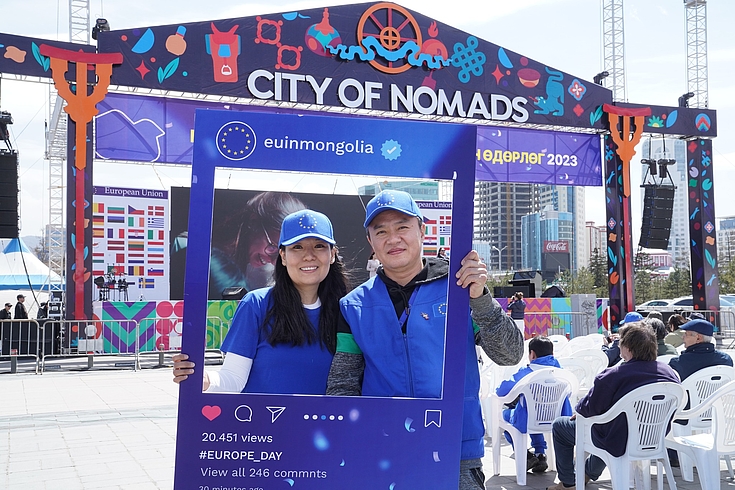
The EU presents itself in the 'City of Nomads' in Ulaanbaatar.
Neutral, but oriented towards the west
Especially after the Russian attack on Ukraine, Mongolia plays an important role for the international community as an 'island of democracy'.
Mongolia positions itself as neutral and emphasizes that peaceful relations are of the utmost importance, especially with its immediate neighbors. However, it also emphasizes third-neighbour policy in the same breath. This was also evident at the “Europe Day 2023”. The interest in travelling to Europe, its institutions and organizations is unbroken. The EU and its member states are also striving to maintain good relations with Mongolia. For example, following the G7 summit in Japan, the french President Emanuel Macron paid a state visit to Ulaanbaatar.
The Hanns-Seidel-Foundation will celebrate its 30th anniversary in Mongolia this year. In the future, we will continue to promote exchange in the legal field and, since last year, also in the environmental field.