
Visit
Institutional Meetings and Professional Exchange in the Republic of Korea
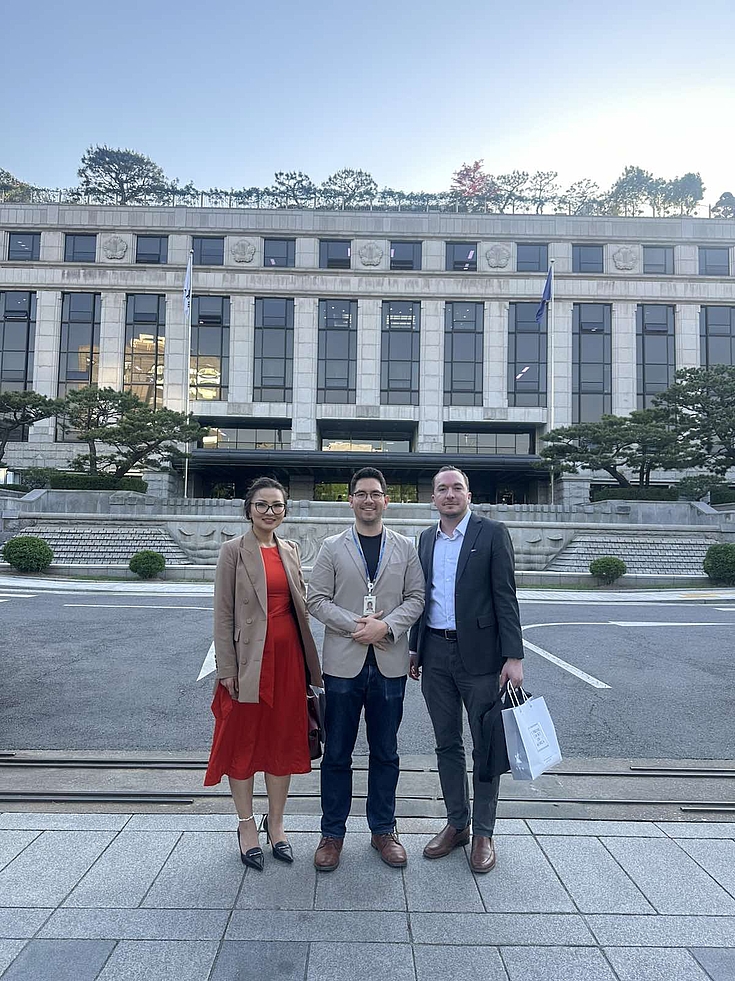
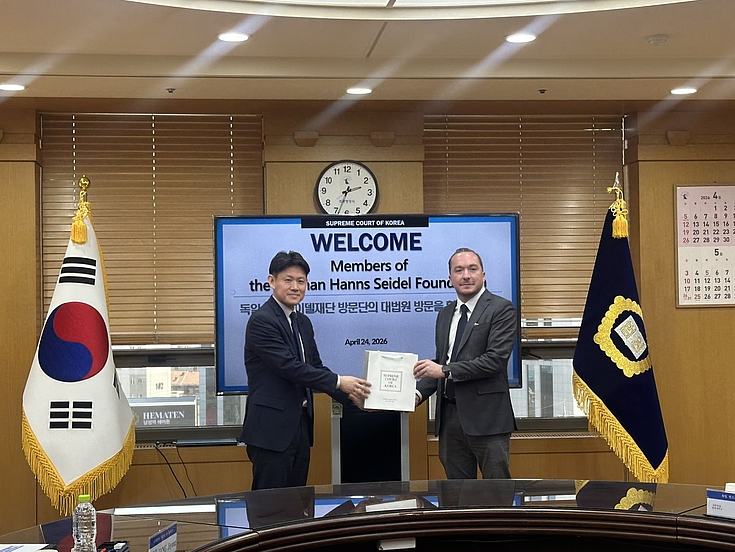
Visit to the Supreme Court of the Republic of Korea
Within the framework of the visit to the Supreme Court of the Republic of Korea, professional discussions were held on international cooperation as well as on the structure and functioning of the judiciary.
On the part of the Supreme Court, high-ranking representatives of the Department for International Relations participated, including:
Mr. Jiyong Jang, Head of the Department for International Relations and Judge
Dr. Ms. Kim Eun Sil, Deputy Head of the Department for International Relations
The discussions focused on international judicial cooperation, the coherence of different legal systems, judicial independence, as well as mechanisms for ensuring the uniform application of the law. In addition, the importance of international cooperation of the judiciary for deepening mutual understanding between different legal systems was emphasized.
Furthermore, the development of the Mongolian judicial system, the activities of the Hanns-Seidel-Stiftung in Mongolia, joint projects with Germany, as well as the preparation and significance of the 100-year anniversary of the Supreme Court of Mongolia were discussed.
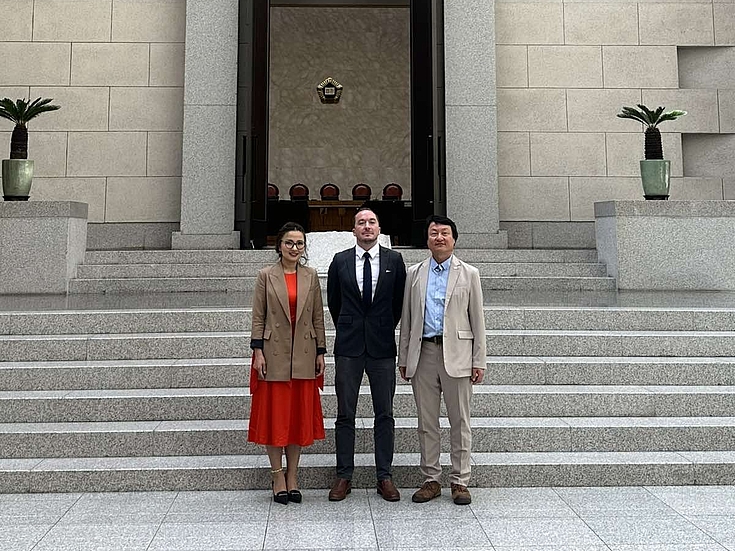
Visit to the Constitutional Court of the Republic of Korea
At the Constitutional Court of the Republic of Korea, a professional exchange took place with Mr. Fabian Düssel, Deputy Director of the Association of Asian Constitutional Courts and Equivalent Institutions (AACC).
Within the framework of the discussions, constitutional review mechanisms in Asian member states as well as in the Republic of Korea and the protection of fundamental rights were addressed.
The discussions concentrated on the tasks of the Constitutional Court, mechanisms of legal protection, as well as its importance for strengthening democracy and the rule of law. In addition, comparative perspectives of constitutional court systems as well as possibilities for deepening regional cooperation were exchanged.
Meeting with the Hanns-Seidel-Stiftung in Seoul
Following the institutional visits, an official meeting with the Hanns-Seidel-Stiftung (HSS) in Seoul took place.
Within the framework of the discussion, the regional activities of the Foundation as well as the thematic priorities of the ongoing programs were presented and discussed. Particular focus was placed on the professional exchange regarding the projects implemented in the Republic of Korea and in Mongolia. This enabled a deeper insight into different contextual frameworks and their influence on the design of the respective project approaches.
Furthermore, differences in the implementation of the Foundation’s work in the two countries as well as its adaptation to local political, societal, and institutional conditions were discussed. This comparative perspective contributed to gaining a better understanding of the regionally differentiated working methods of the Foundation.
Moreover, possibilities for further deepening cooperation between Mongolia, the Republic of Korea, and European partners were discussed.
Finally, the importance of international cooperation for the promotion of democratic governance, good governance, as well as sustainable development was emphasized, particularly with regard to the significance of context-sensitive and regionally adapted approaches in project work.
Conclusion
The working visit to the Republic of Korea enabled a deeper insight into the structure and functioning of the judiciary as well as into the system of constitutional review. At the same time, it provided a valuable opportunity to gain practical experience in the field of international cooperation.
The meetings with the Supreme Court, the Constitutional Court, as well as the Hanns-Seidel-Stiftung clearly demonstrated the central importance of international cooperation for the promotion of the rule of law, human rights, and democratic development.
The knowledge gained makes an important contribution to further project work, academic research, as well as comparative legal analysis.